
Creating and Capturing Value: Peter Thiel's 'Zero to One' Applied to Your Product Career
Unconventional Strategies for PMs Seeking Monumental Career Growth

One of my favorite books in business happens to be a contrarian take on building startups and businesses. Peter Thiel’s book "Zero to One: Notes on Startups, or How to Build the Future" came out in 2014, which he co-wrote with a student at Stanford where he was teaching a class on building startups, the student Blake Masters took detailed notes and both turned it into a book. The book has since then become a cult classic, let’s first unpack some of the key concepts.

Meta concept: From 0 to 1, Not 1 to N
The "Zero to One" concept, represents the idea of creating something entirely new and groundbreaking, as opposed to merely iterating on or duplicating what already exists. Thiel presents this as the primary way to achieve significant advancements and build a successful startup.
In contrast, the path from "1 to N" involves copying things that work—taking a working model and expanding or improving it. Thiel acknowledges that these horizontal, iterative progressions can be profitable, but they are not the kind of game-changing innovations that transform industries and societies.
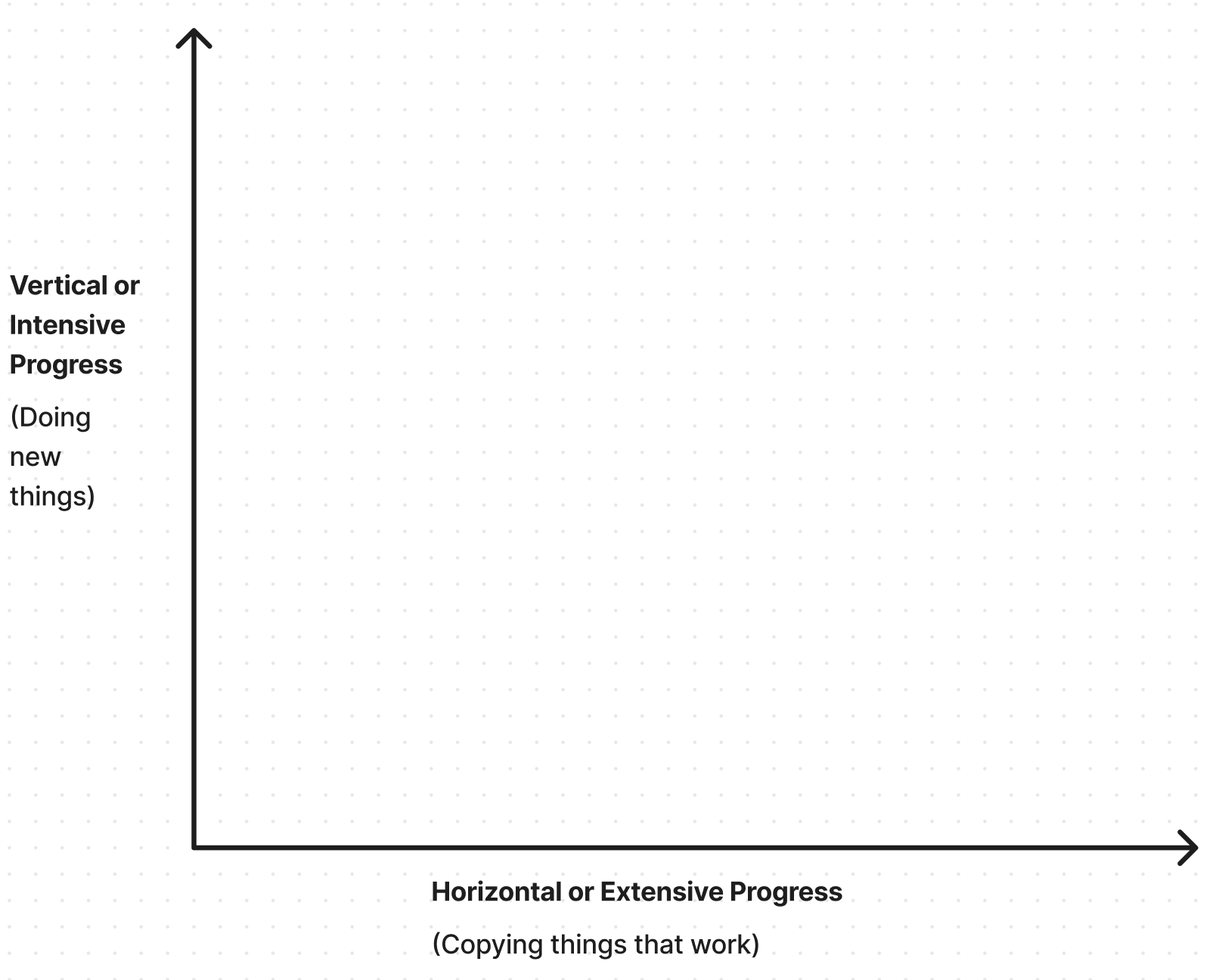
Here's how the concepts challenge conventional thinking:
1 to N or Horizontal Progress: This is the default choice for most Chinese companies and many industries because it's safer and easier to understand. It involves taking a known concept, product, or idea and expanding it to new markets, improving it incrementally, or building a similar product that can compete with existing ones. Examples include going from one typewriter to many or from a localized taxi business model to a globally scalable ride-sharing app. This kind of innovation is essential, but according to Thiel, it tends to only create incremental improvements rather than massive leaps forward.
0 to 1 or Vertical Progress: Thiel argues that the most significant achievements come when a company or individual innovates in a way that takes us from "0 to 1"—from nothing to a new creation. This kind of innovation involves doing something that has never been done before, like inventing the first computer or creating a unique business model that transforms an industry. Thiel's example of a "0 to 1" business is Google, which became so successful at what it does that it has effectively monopolized the search market. This kind of radical innovation is often riskier and more challenging than "1 to n" but also has the potential for much greater rewards.
According to Thiel, startups should strive for "0 to 1" advancements. These are the types of leaps that truly move the needle and allow companies to establish a monopoly, a position from which they can shape their own futures and potentially change the world.
1. The Power of Monopoly
Contrary to the belief that competition fosters innovation, Thiel argues that monopolies are the key to a successful business. In a perfect competitive environment, companies are too busy fighting for market share and barely making profits. However, monopolies (not the illegal or political favorites) can afford to think long-term, innovate, and provide significant value for society. Thiel's own company, PayPal, was a good example of a monopoly that disrupted the payment industry.
2. The Myth of Luck
Thiel emphasizes that good businesses are not merely a product of luck but require careful planning and strategy. While many Silicon Valley entrepreneurs think that success is random and unpredictable, Thiel suggests that such a mentality leads to risky gambles rather than sustainable businesses.
3. The concept of Power Law (or Pareto Principle)
Thiel discusses the power law in the context of venture capital, where a small number of investments generate most of the returns. This principle is contrary to the conventional thinking of portfolio diversification. Thiel suggests focusing resources on fewer, potentially higher-impact areas.
4. Secrets and the Importance of Uniqueness
Thiel encourages entrepreneurs to search for "secrets" or unexplored areas of knowledge, which is where breakthroughs and "zero to one" changes occur. Conventional wisdom in Silicon Valley often promotes iteration and incremental improvement on existing knowledge, but Thiel advocates for the pursuit of unique, novel ideas.
5. The Value of Definite Optimism
Definite optimism, as Thiel defines it, is the belief in a better future that you can plan and work towards. This contrasts with the indefinite optimism of many in Silicon Valley, who believe in a better future but have no concrete plans to bring it about. Thiel asserts that definite optimism was prevalent in the past when people had grand visions for society (like going to the moon), and he encourages a return to this kind of thinking.
6. The Importance of Founding Teams
Team dynamics are essential in startups. Thiel underscores the importance of founders sharing a pre-existing, strong personal relationship. This goes against the Silicon Valley norm, where professional relationships and skills tend to be valued more highly.
7. The Sales and Distribution Paradox
Many engineers in Silicon Valley undervalue the importance of sales and distribution, considering them secondary to product development. Thiel, however, insists that a good product doesn't sell itself, and a robust sales strategy is just as critical as a good product.
8. The Last Mover Advantage
While the technology industry often prizes being the first mover, Thiel suggests that being the last mover—that is, making the last great development in a specific market and enjoying years or even decades of monopoly profits—is more advantageous. This concept encourages the pursuit of durability, not just novelty.
9. Competition is for Losers
One of Peter Thiel's most contrarian perspectives in "Zero to One" is his view on competition. The widely accepted notion in business is that competition is good—it drives innovation, benefits consumers through lower prices, and keeps businesses efficient. However, Thiel argues exactly the opposite: "competition is for losers".
According to Thiel, if you're competing fiercely with others, you're unlikely to be successful in the long run. Instead of striving for a slice of an existing market, businesses should aim to create and dominate a new market entirely, effectively forming a monopoly.
He contends that in a highly competitive market, businesses are forced to cut prices and costs, which erodes profitability. On the other hand, a monopoly enjoys substantial profit margins, which can be reinvested in long-term growth and innovation.

Thiel uses the example of Google, which essentially has a monopoly in the search engine market. This has allowed Google to generate significant profits, which in turn has funded projects like Google Maps, Gmail, and self-driving cars.
Thiel's view is that the best businesses avoid competition. Instead, they seek to create something so unique and valuable that no other business can offer a close substitute. This allows the business to capture and sustain a large portion of the value it creates.
So, Thiel's advice to entrepreneurs is to start by aiming to dominate a small niche market, and then gradually expand into related and slightly broader markets—always aiming for monopoly rather than competition.
This perspective upends conventional wisdom on competition, but it's a central thesis of Thiel's book and key to his thinking on how businesses can best create and capture value.
10. Creating and capturing value
A startup is a business that is structured to create and capture significant value by providing a unique solution to a problem.
The distinction between creating and capturing value is crucial. Here's how Thiel breaks it down:
Creating Value: This refers to the ability of a business to develop products or services that are beneficial to society. It is about generating something of value that didn't exist before. A company can create enormous value without necessarily becoming valuable itself.
Capturing Value: However, creating value is not sufficient for a business to be successful. A company must also capture some of that value for itself, in the form of profit. This means that it must have a business model that allows it to generate revenue and ultimately profit from the value it creates.
Thiel argues that too many companies in Silicon Valley focus on creating value but forget the equally important task of capturing some of that value. For example, he mentions Twitter as a company that, despite creating significant value by changing how people communicate, initially struggled to capture value due to lack of a robust business model.
On the other hand, a company like Google has been successful at both creating and capturing value. It created value by radically improving internet search and captured value through targeted advertising, thus becoming one of the most profitable companies in the world.
The takeaway from Thiel's formula is that for a startup to be truly successful, it must do more than just create value; it must also have a strategy for capturing some of that value for itself.
The focus of your startup should be on capturing value.
“X” is the value your business creates.
“Y” is the percentage of X that your business actually captures.
X and Y are independent variables.
One can create a lot of value, and capture none of it. For example, most PHD students and scientists create value, but rarely capture any of it. Or you can create a small value, but capture all of it. You have to make sure you understand both of these variables.
Primary miss-understanding here is that creating innovations with stellar value for society will turn into cashflow but that is not always true. Infact Naval Ravikant has a popular quote on this.
Build something that society wants but does not yet know how to get it. – Naval Ravikant.
Although this is partially true, I agree with Thiel that meterly creating is not enough, restaurants and airlines create a lot of value but are not able to capture most of it. A healthy strategy that Elon abides by and mentioned in an interview is to create more than what you capture, which is a great strategy to stand out.
11. The Principle of Boldness
In "Zero to One," Thiel emphasizes the importance of boldness in entrepreneurship. To him, timid iterations on existing products or services will not lead to groundbreaking innovation or substantial business success.

He believes in the power of definite optimism – a worldview where the future will be better than the present if one plans and works to make it better. This contrasts with indefinite optimism, where the future will be better, but one does not know how exactly it will get better. According to Thiel, Silicon Valley and the world at large have moved more towards indefinite optimism, which can lead to a lack of long-term planning and bold ideas.
In the context of startups, boldness means pursuing ambitious projects and goals, even in the face of uncertainty and risk. It means daring to think differently, challenging established norms, and having the audacity to attempt to create something radically new and innovative, as per the "Zero to One" philosophy.
For example, a bold startup might aim to revolutionize an entire industry, solve a previously intractable problem, or create a product that never existed before. Thiel suggests that this kind of audacious thinking and action is essential for startups aiming for significant success.
By advocating for boldness, Thiel is challenging the more cautious, risk-averse tendencies that can be prevalent in business and entrepreneurship. It's another way that Thiel's philosophy can be seen as contrarian. He argues that in the realm of startups and innovation, playing it safe is often the riskiest move of all. Instead, he encourages entrepreneurs to take calculated risks, embrace bold visions, and strive to change the world.
What can Product Managers lean from these concepts, both for their careers and the products they build?
1. The Power of Monopoly
As a Product Manager (PM), it's crucial to seek roles where you can develop and manage unique products that serve a specific market need and offer differentiated value. This could mean working in companies that are not just creating another 'me too' product, but are truly innovating. In this kind of environment, you'll be pushed to think creatively, develop deep user empathy, and gain expertise in delivering unique value propositions. Over time, this experience will make you a far more effective and sought-after PM.
I do not mean monopolizing your career as a PM in a pajoritive way, but to think it through in a tactial and strategic way. For example one of the reasons Tesla is successful is that it is vertically integrated, from marketing (our CEO Elon Musk is the the primary marketer), in-house design, manufacturing, and even distribution with our Tesla Stores. This keeps the cost of the car down and makes Tesla a great profit. As a PM in their career, being vertically integrated would help too, how? By being full-stack.
Understand how demand generation works in your company
Understand the technology, evene if you are a functional PM
Understand how pricing works
Under stand how sales & marketing or distribution works
If you can speak for any stakeholder that you work with, you are on your way to be vertically integrated as a PM.
2. The Myth of Luck
I strongly believe in the adage that there is no fate, only what you make.
And while it may see like your friend who got into that great PM role at Google “just got luck” I can assure you it is furthest from the truth, it's essential to recognize that the most significant factor in your success as a PM is your actions and decisions. Rather than passively waiting for opportunities to come your way, actively seek them out. Cultivate a deep understanding of your industry, develop strong relationships with mentors and leaders, and consistently push yourself to learn and grow.
Create and update a list of strengths and weaknesses, then create a go-to-market-strategy-like plan to penetrate a particular job or industry. And entering is not enough, you will need to thrive as well.
Most great PMs that I have met can answer these questions effectively:
Why do I love being a PM?
Why do I love being a PM fot this product?
Why do I love being a Pm for this company?
Because a B2B product’s day to day looks very different from a B2C or an API PM isvery different from a customer facing mobile PM. You need to know what you are good at, what you want and how to get it. Which isa segway to the next principle.
3. The concept of Power Law (or Pareto Principle)
In your work as a PM, realize that a small number of your decisions and tasks will have a disproportionately large impact on your product's success. Identify these tasks and focus your energy there. Similarly, in your career, a few key decisions - like the company you join, the mentor you choose, or the projects you take on - can significantly impact your trajectory. Make these decisions with care and due consideration.
99% of your actions may not give you the results that you want and may seem useless, but to get to the 1% that do you need to still go through the 99%.
– Naval Ravikant
This is a hard one since it is so personal to everone and needs deep self realization of one self, constand self reflection and a strong feed back look into what has worked in the past for oneself in their PM career. One caveat is that the market is always shifting, last year the hot thing was crypto today it is Generative AI. A good framework here is to try to cut through the noise and try to understand what wont’s change, and extrapolate from there.
4. Secrets and the Importance of Uniqueness
PMs need to be naturally curious, need to learn fast and their pace of upskilling has to increase as well. This can be daunting in the beginining but then comes natually.
As a PM, your ability to uncover 'secrets' - insights about your customers, market, or product that others don't see - can be your superpower. It can lead to breakthrough product features, innovative strategies, and effective solutions to your customers' most pressing problems. Invest time in user research, data analysis, and experimentation to uncover these secrets.
But the secret that works for someone’s career may not apply to yours, so here being authentic and honest to oneself helps.
5. The Value of Definite Optimism
Adopt a mindset of definite optimism for your career. Envision a clear, ambitious future for yourself and then work backwards to identify the steps you need to take to get there. This could include acquiring new skills, building a strong network, or gaining experience in specific industries or roles.
Most of us in the west have been programmed to believe that things will always get better and society will always progress, the recent pandemic and the war in Ukraine have jolted the global economy and changed the macro-economic landscape drastically in the last four years. This should teach us that we always need to try to be ready for extreme shift in the macro. As Intel’s Ex-CEO Andrew Grove’s describes “Only the paranoid survive” being aware of the macro will help you plan for the future.
6. The Importance of Founding Teams
Your success as a PM is largely dependent on your ability to work effectively with your stakeholders. Seek to build strong, collaborative relationships with your 'founding team' - the engineers, designers, marketers, and other stakeholders you work with on a daily basis. Foster an environment of open communication, mutual respect, and shared ownership.
7. The Sales and Distribution Paradox
While your main responsibility as a PM might be to develop great products, don't neglect the importance of effective sales and distribution. Understand your company's sales channels, pricing strategy, and competitive landscape. Use this knowledge to guide product development decisions and collaborate effectively with sales and marketing teams. Knowing which features can translate to higher sales can be the difference between a definite or a lost promotion. Create and maintain close relationships with marketing and sales to gather insights. Optimize your A/B tests to match expectations. If you work for a company that reports sales to its invetors, knowing which features will be important right before end of quarter will help you priritize your roadmap better.
In my first job I worked at Time Of India’s fin-tech arm as a marketer and was later pulled in for a role of an associate product manger, because I had an intimate knowledge of the customer’s needs, pricing model, distribution channels, competitive landscape and so on.
8. The Last Mover Advantage
As a PM, it's tempting to rush to launch new features or products. But Thiel's principle of the 'Last Mover Advantage' reminds us that long-term success often comes from building products that deliver enduring value, not just short-term excitement. Ensure your product decisions are guided by a long-term strategy and a deep understanding of your customers' needs.
9. From 0 to 1, Not 1 to N
Strive to create products that take your company from 0 to 1. This could mean developing entirely new features, re-imagining existing products, or venturing into new markets. These kinds of initiatives are often riskier and more challenging, but they also offer the greatest potential rewards - for your company and your career.

All of us may not get to work on the next Vision Pro, but the concept is about thinking from first principles. De-construct your entire product and think it through, knowing what you know now would you have built what you did 3 years ago, how would your Product Roadmap look like? At Tesla thinking from First Principles is not just encouraged, it is a necessary metric for employee-performance that’s tracked by all managers.
10. Competition is for Losers
Humans are naturally competitive, and PMs are no different. Often because they had go through an education system which encourages competing with fellow students, from the very start of getting into a good college. But as Thiel describes that competition and war are expensive for companies and countries, same goes for our careers. Being a team player is just good business sense.

It is very easy to get sucked into corporate politics, avoid the trap and avoid competition. Instead, focus on how you can add unique value and drive forward the goals of your team and your company. Again, I do not mean do not be bold, confident or assertive, I mean from strategic stand point position yourself deliberately, there may be overlaps between what you do and for example what the program manager does or a designer does, have a 1:1 with them and reduce repetitive work which is unproductive. Also with other PMs that may own other upstream or down stream applications, do not de-prioritize their features just because they’re down stream and have a dependency on you. PMs often have to compete for their features to be prioritized on depending team’s roadmaps.
Similarly, when it comes to your product, aim for differentiation over imitation. Seek to understand your customers and their needs better than anyone else, and use these insights to create a product that stands out in the market.
11. The Principle of Boldness
Don't be afraid to take risks, propose ambitious ideas, and challenge the status quo. This boldness can set you apart and position you as a leader within your team and your organization. It can also lead to the most rewarding and impactful work of your career. This could also mean thinking outside the box, like taking an improv class if you’re shy or want to improve your communication, starting a blog or a side-hustle that’s related to product Management or your industry. This will not only signal to your employer that you are serious about your career growth, but also improve your confidence and help you be a better PM.
Lastly, do not be afraid to challenge the HIPPO (Highest paid person’s opinion) in the room, if you do this effectively and if the executive has high integrity, they will respect you for the pushback.
12. Creating and Capturing Value
Peter Thiel's concept of startups needing to both create and capture value can be directly applied to the role of a Product Manager.
Creating Value: As a PM, your primary role is to create value. This could be by developing new products, improving existing ones, optimizing user experiences, or solving customer problems. The value you create can take many forms, but it's ultimately about making something that benefits your customers and your company. Creating value is not only about product development, it's also about communication, leadership, and relationship-building. Each of these areas can be an opportunity for a PM to create value within their organization.
Capturing Value: In the context of a PM's career, capturing value can mean leveraging the value you create to advance your career. This could involve taking credit for your successes, showcasing your work to leaders within your organization, using your achievements to negotiate promotions or raises, or just simply getting a fair compensation for your work.
Pro Tip: Unless you are an unpaid intern you will be paid and if you are trying to break into a new industry try not to over negotiate your offer, this will keep you competitive from the other candidates.
Create more value that you charge for.
– Elon Musk
Capturing value can also mean using the experience and skills you gain in your role to open up new career opportunities. For example, the leadership skills you develop as a PM can prepare you to take on senior management roles. Similarly, the technical and market knowledge you gain can position you for roles in related areas like product marketing or strategic planning.
Understanding and applying this principle of creating and capturing value can help a PM not only to be more effective in their role, but also to navigate their career more strategically.
In conclusion, the principles of Peter Thiel's "Zero to One" offer invaluable insights for both startups and Product Managers alike. Just as startups are tasked with creating something unique and valuable from nothing, PMs must navigate their careers with a similar mindset—embracing monopolies, focusing on value creation and capture, defying competition, and pursuing bold, innovative solutions. By understanding these principles and applying them effectively, PMs can not only excel in their roles but also supercharge their career progression. Through this lens, every decision made and project undertaken becomes an opportunity to propel from zero to one, pioneering the path to an exceptional product management career.